How do social media surveys work?
We'll explain why they are a true revolution for the market research sector and walk you through exactly how they work.

01. Why use social media?
The market research industry was born in the early 20th century. Through successive technological revolutions, data collection methods have continually diversified, with the most innovative approaches regularly overtaking existing ones. In the early 1900s, the first surveys were conducted face-to-face right on the street.
Later, the widespread adoption of the telephone in the 1970s made it possible to streamline survey costs and timelines while achieving a much broader geographical reach.
But then came the internet. By the late 1990s, the digital revolution disrupted the industry entirely. Researchers no longer needed to manually administer questionnaires to every single individual; they could now distribute surveys online to panels of internet users to collect thousands of responses simultaneously.

Strengths and limitations of the three traditional data collection methodologies
Face-to-face / CAPI (Computer Assisted Personal Interviewing)
Strengths
- Access to respondents without internet or phone
- Ability to step outside the interview guide framework
Limitations
- Need for trained staff
- Time-consuming
- Bias related to contact with the interviewer
- Expensive
Telephone / CATI (Computer Assisted Telephone Interviewing)
Strengths
- Access to a larger population
- Ability to step outside the interview guide framework
- Geographical targeting from a distance
Limits
- Need for staff and training
- Time-consuming
- Biases related to contact with the interviewer
- Decrease in the use of landlines and difficulty in obtaining mobile numbers
- Growing reluctance towards calls from unknown sources
Online panels / CAWI (Computer Assisted Web Interviewing)
Strengths
- Easy to program and administer on large samples
- Little need for human resources
- Speed of execution and fieldwork
- Cost-effective
Limits
- Exclusively for literate populations with internet access
- Professionalization of certain respondents
- Limited qualitative data
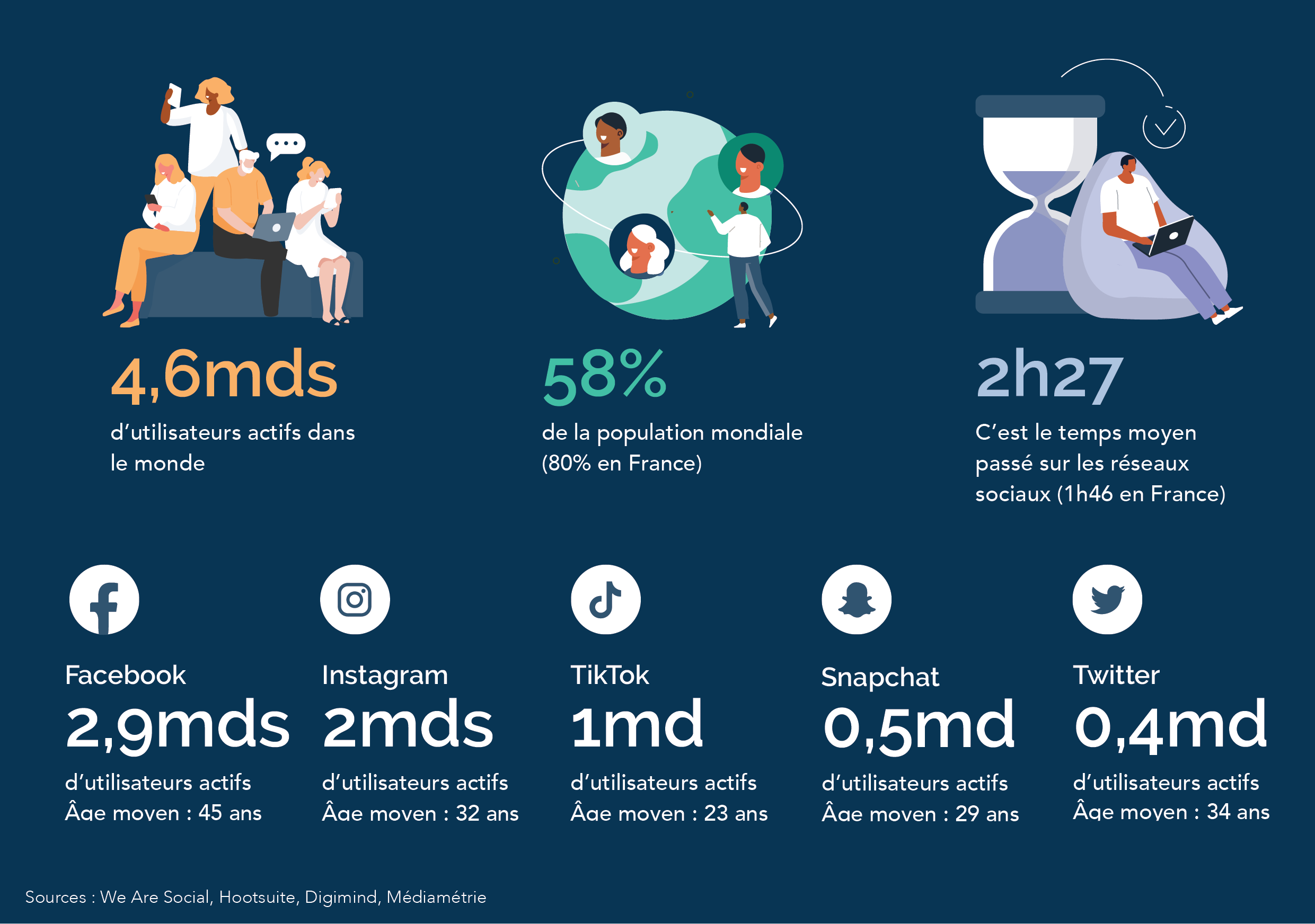
Today, the power of social networks represents a significant opportunity for quantitative studies. In France, 80% of the population uses social networks.
The time each individual spends there daily averages around 2 hours.This represents nearly 20% of awake time!Your targets spend a large part of their free time on social media: it’s therefore the ideal place to question them about your issues.
Social media in 2022
02. How does it actually work?
Social media advertising as a targeting tool
Social media today offers the opportunity to target all users based on specific criteria: socio-demographic, geographic, and by interests. This targeting, initially intended for the dissemination of advertising content by advertisers, becomes, in our context of quantitative studies,a valuable tool for prequalification and recruitment of respondents.
The methodology of studies on social media relies on the advertising and its precise targeting criteria.
The principle is simple:
Define the target of the study
according to its objectives.

Create posts (posts and stories)
a visual accompanied by a message inviting feedback.

Launch an advertising campaign
that promotes these posts to the target population using the targeting criteria of social media.

Monitor the collection of responses from targeted users
by especially tracking the filling of quotas.

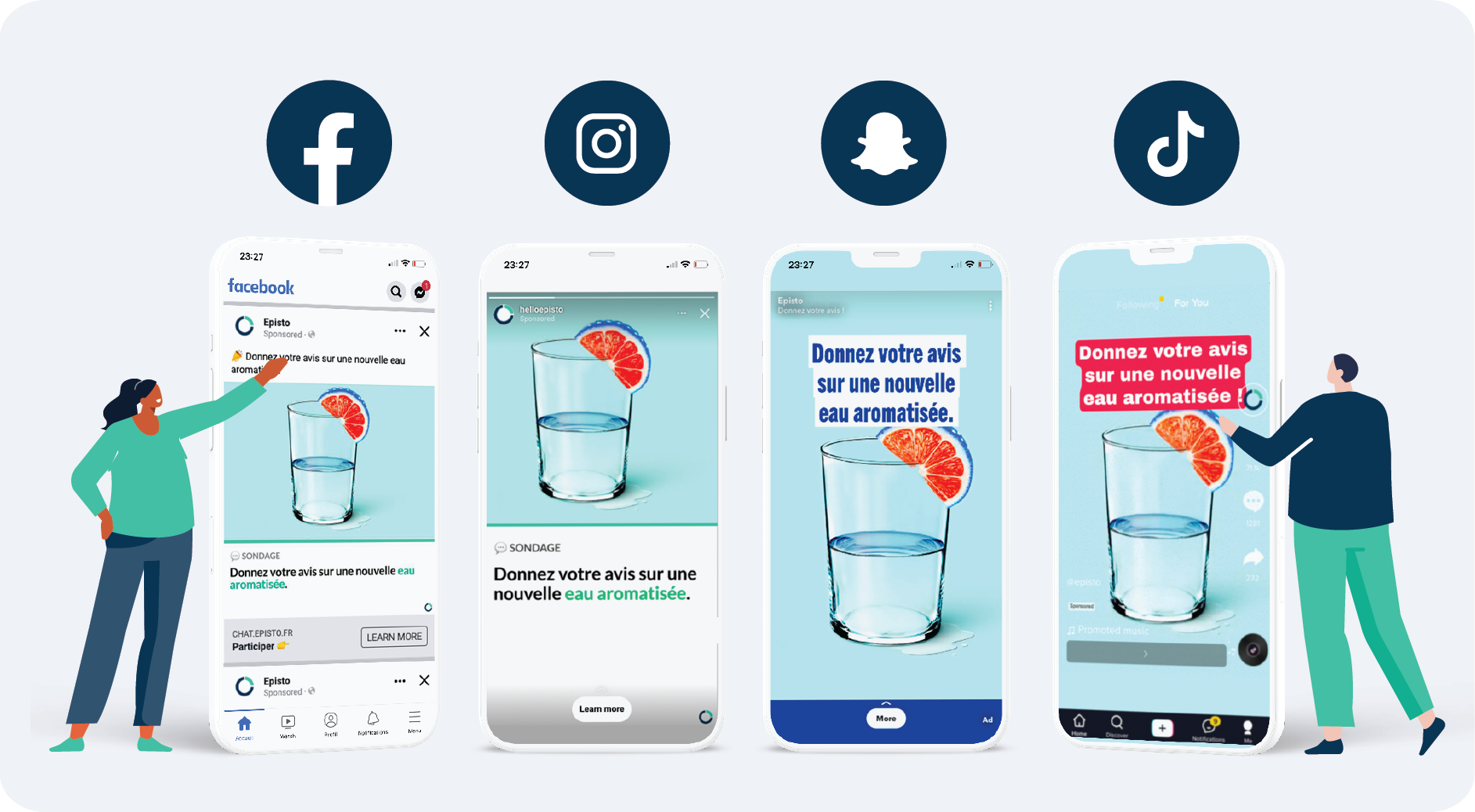
At Episto, we primarily use Facebook and Instagram to recruit our respondents. But also Snapchat and TikTok if the defined objective allows it.
The conversational questionnaire as a collection mode

Well-targeting respondents is crucial. But then it's about administering a questionnaire that they will enjoy completing, all the way to the end!
If interested in the advertisement,targeted users are just one click away from becoming respondents of the study.
They are then redirected to the questionnaire, which they can answer directly on their smartphone.
The main challenge of social media studies is to offer each individual a pleasant experience, through an easy-to-understand and smooth questionnaire.
At Episto, that's what we do through an engaging conversational format.
What is an engaging conversational questionnaire?
It is a survey designed to look and feel like a natural conversation on an instant messaging app:
- The look and feel of a familiar application
- Varied question types
- Emojis
- Questions that appear dynamically as the "discussion" flows
- An engaging tone with appropriate vocabulary that is neither too casual nor too formal
Attention!
While respondent engagement is essential for gathering quality responses, this method may not be suitable for certain case studies. Two scenarios fall into this category, and based on your questionnaire, we can discuss alternatives and possible solutions together.
If your questionnaire involves a device that is too complex
That is, it requires technical arrangements such as activating a webcam for doingeye-tracking for example.
If your questionnaire is necessarily long
That is, it consists of more than 60 questions and its completion time is therefore over 15 minutes. In this case, it will not be suitable for this methodology, especially for mobile use and the non-compensation of respondents.
Read next

Articles
AI-powered research for better insights
Discover how AI transforms every step of your surveys to gather reliable and actionable insights in just a few clicks.

Articles
The 8 best questions from our CSMs to ask AI Insights 🪄
AI Insights, Episto's new AI assistant, analyzes your studies and answers your questions with optimized prompts to compare, segment, and structure your results.