7 effective formats to share your insights
Discover 7 ways to share and enhance your insights, from analysis reports to workshops, to turn data into action and maximize their impact.

Insights allow you to turn data into concrete actions. They illuminate decisions, inspire teams, and guide the development of products and services. However, the value of an insight depends not only on how it is collected, but more importantly, on how it is shared. Here are 7 proven methods to maximize the impact of your insights and disseminate them effectively within your organization and beyond.
1. The Analysis Report: The Classic, Structured Format
The analysis report remains the most common format for presenting research findings. To truly captivate your audience, simply accumulating data isn't enough; you must build a narrative. Select only the most critical information and highlight it using clear data visualizations and impactful headlines. This report can then be hosted on internal platforms to ensure continuous accessibility across teams.
Tips :
- Do not overload the slides: each title should correspond to a single message.
- Favor engaging visuals to enhance the impact of the data.
- Tell a story to organize your ideas and ensure smooth delivery.
Virginie Sappey (Marketing Director at FranceTV Publicité) remarks:
"In terms of dissemination and presentation of insights, we have industrialized deliverables with multiple formats: a one-pager to have a one-minute overview of the study results, a press release with the 3 key results, and a more enriched version. Generally, these 3 templates are produced for each study, stored, and shared."
2. The oral presentation: engaging your audience
Presenting your insights in person whether in a meeting or at an event is a powerful way to convey your message. A live presentation adds an interactive dimension that captures attention and encourages discussion. In some cases, inviting an external speaker can offer a fresh perspective and add more weight to your conclusions.
Tips :
- Use visual aids and catchy terms to energize the presentation.
- Don’t hesitate to involve multiple speakers to make the presentation dynamic and collaborative.
- Make it accessible to all by sharing the presentation (and/or the recording).
Hervé Bridoux (International Consumer Insights Manager at Auchan Retail) mentions:
"In our corporate culture, a presentation by an external person often has more impact. I hardly ever present study results myself except for the summaries: I always let the institute handle it."
3. The Pitch: the high-impact summary
When time is limited, a concise pitch is ideal. This format consists of conveying key insights in a few minutes, focusing on what matters for the person you are addressing (the key insights differ depending on the team you are speaking to). The pitch is often preferred in interactions with executives, as it gets right to the point and facilitates quick decision-making by integrating actionable conclusions. Here are our recommendations for building it...
Structure:
- Briefly recall the context of the study: Why was this survey conducted (context, initial hypotheses, etc.) and what are its main characteristics (sample, methodology, etc.)?
- Present three main insights: Focus on findings that are surprising, validate or invalidate your initial hypotheses, or have a direct impact on the business.
- Propose a plan of action moving forward: How will these insights be turned into concrete actions?
Olivier Hullot (former Lead Insights & Analytics France at Pepsico) explains:
"In face-to-face situations, we can distill exactly what our interlocutor needs to know, in an impactful manner, taking into account their reactions and concerns."
4. Media Formats: videos and podcasts for easy adoption
Videos and podcasts are engaging formats perfectly suited for sharing insights. Highly consumable, they can be easily distributed across various channels such as social media, intranets, or during internal meetings. These formats allow you to reach a wider audience in a memorable and more informal way.
Best practices:
- Create short formats: Limit the number of messages to maintain audience attention.
- Disseminate them widely: Share assets broadly, including with teams not directly involved in the study.
- Store them centrally: Host them on an easily accessible intranet platform for everyone.
Dominique Levy Saragossi (Founder of George(s)) explains:
"I believe we need to adopt formats that correspond as closely as possible to the 'natural' way our interlocutors consume information: audio, visual, or both, and broken down."
5. Experiential events: creating a memorable experience
Event formats such as exhibitions, staged performances, or immersive meetings offer a unique and memorable approach to sharing insights. By evoking emotions in participants, these formats make it easier to absorb the results and significantly enhance their impact.
Event format ideas:
- Meetings between clients and internal teams for direct immersion.
- Visual or scripted installations to present results in an immersive way.
- Exhibitions on your own premises to engage entire teams.
Emmanuel Malard (Market Research & Brand Solutions Strategist at Qualtrics) discusses it:
"As an insight manager, we need to create emotion within top management: they remain consumers like everyone else so we need to make them shed a tear, make them smile, if we want to accelerate the consideration of the findings of the studies."
6. The workshop: co-creation for concrete solutions
The workshop, besides being a time dedicated to information transfer, allows us to go beyond. By integrating various teams and involving them in reflection, this format promotes co-creation of solutions based on insights. It’s a moment of collaborative exchange that allows you you to define.
Suggested format :
- Share the insights from the study in question with all participants before the workshop.
- Start the workshop on the D-Day with a roundtable discussion of insights that stood out to participants.
- Use post-its so that everyone can propose actions in response to the insights.
- Bonus: in a role-play, encourage participants to put themselves in the clients' shoes to better understand their needs.
Judith Roucairol (Director of Consumer Evaluation for make up & color science at L’Oréal) discusses it:
"To truly grasp the consumer's reality, certain things work well: for example, workshops where we integrate very different professions."
7. The data visualization platform: empower the teams
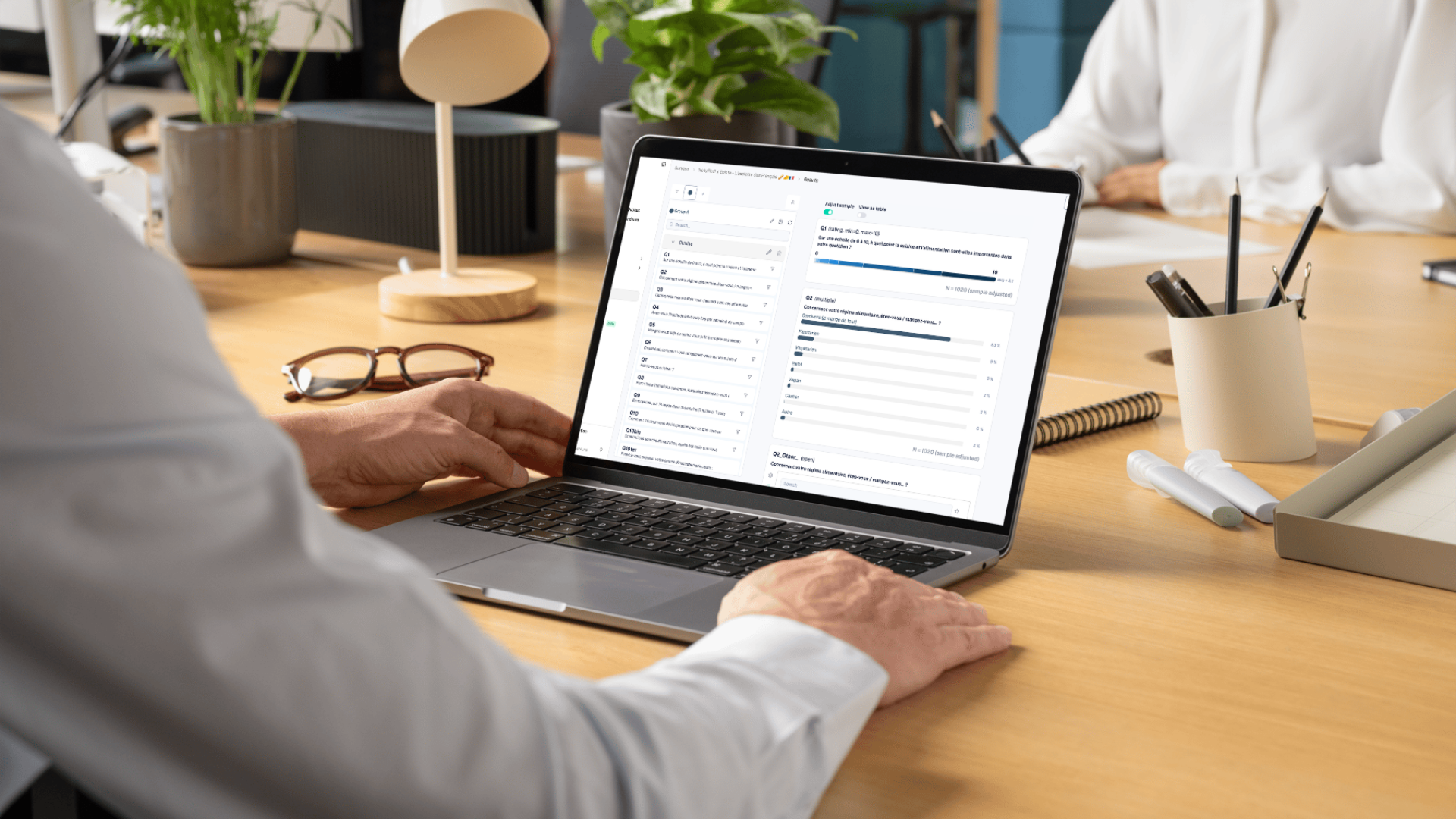
Granting access to insights via a data visualization platform makes teams more autonomous and facilitates a deep understanding of the results. Users can explore data in depth, compare populations, and generate visual reports tailored to their needs.
Benefits :
- Gain a comprehensive view of the study results.
- Visualize insights clearly and in a customizable way.
- Facilitate access to insights for the entire organization for quick decision-making.
Emmanuel Malard on the subject:
"Everything related to data visualization today is extremely practical and enlightening."
Conclusion
The choice of how to share your insights depends on the audience, the message, and the desired impact. Whether it's an oral presentation to inspire teams, a workshop to co-create actions, or an interactive medium to capture attention, each of these methods offers a unique way to convey and enhance your insights. Adopting these varied formats ensures that your findings do not remain just data, but become powerful levers for action within your organization.
Discover how Episto can assist you in collecting your insights from all your targets with solutions adapted to today’s needs.
And to continue the reflection.
- Find all our tips on how to effectively build these 7 restitution formats in our Dedicated Guide
- and discover all the expert interviews from which the quotes in this article are extracted, in our White paper: Reinventing the insights function
Next read
Articles
AI-powered research for better insights
Discover how AI transforms every step of your surveys to gather reliable and actionable insights in just a few clicks.
Articles
The 8 best questions from our CSMs to ask AI Insights 🪄
AI Insights, Episto's new AI assistant, analyzes your studies and answers your questions with optimized prompts to compare, segment, and structure your results.